Microsoft says that features on the list will be either removed from Windows 10 or "not in active development and might be removed in future releases".
Other features facing the axe include the Outlook Express email client, which is replaced with the built-in Mail app, and the Reader app, which will be integrated into Microsoft Edge.
The BBC has contacted Microsoft for comment.
RIP Paint
People have expressed disappointment at the news on social media, with many tweeting "RIP" messages.
Welsh YouTuber Chaotic described Paint as "the greatest thing to have ever existed" - perhaps with tongue in cheek.
The artist known as Jim'll Paint It uses the program to create artwork on outlandish themes, commissioned by strangers. He has nearly 700,000 followers on Facebook.
"Paint hasn't been all that since they messed about with it anyway. I'm running XP on a virtual machine because it's the best one," he tweeted.
"They should just release the source and make it public domain," tweeted games developer Mike Dailly, creator of Lemmings and Grand Theft Auto.
Are you a Microsoft Paint Picasso? Share your Microsoft Paint creations by emailing haveyoursay@bbc.co.uk.
Please include a contact number if you are willing to speak to a BBC journalist. You can also contact us in the following ways:
Google redesigns mobile search app with personalised 'feed'
Google on Wednesday announced an overhaul of its search app on mobile phones to include a personalised feed of links about hobbies, travel, sports and other topics, a move that puts the search company into more direct competition with social networks such as Facebook.
Google, the world's largest search engine and a unit of Alphabet Inc, said the changes would begin rolling out in the United States on Wednesday and other countries in the coming weeks.
The new offering is called "Google Feed", a name that may conjure comparisons to Facebook's "News Feed", a feature on Facebook used to browse updates from friends, family and other sources.
Google said, however, that it was not trying to duplicate Facebook Inc, the world's largest social network. Instead, the company said it wanted to create another place to see a stream of relevant search results.
"This feed is really about your interests ... It's not really about what your friends are interested in," Ben Gomes, a Google vice president for engineering, said in a briefing with reporters.
Typical updates might include a link to a website with tips about an upcoming vacation spot, or a link to a page about cycling or another hobby, the company said.
Facebook and Google are jockeying for attention online and by extension, for advertising revenue based on those eyeballs. The two Silicon Valley companies are expected to take in some 50 percent of overall online ad spending in 2018, according to research firm eMarketer.
There were no immediate plans to include advertising in Google Feed, Gomes said.
Google Feed will suggest links based on a user's Google search history as well as data from other Google services, such as YouTube, Gmail and Google Calendar, the company said.
In addition to putting Google Feed on mobile apps, the company is looking at attaching it to web browsers in some form, Shashi Thakur, a second Google vice president for engineering, said during the briefing.
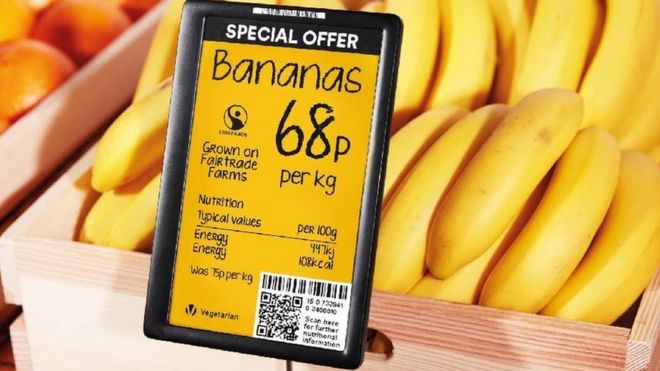
Image copyrightDISPLAYDATAImage captionElectronic price labels like this one can be changed instantaneously
Technology is enabling supermarkets and other retailers to change their prices throughout the day, but why should they want to do this and what will customers think about it?
Many know the dispiriting feeling when the summer holiday flight they had their eye on suddenly goes up £50, or the Uber they call on a Friday night is four times the price they paid the day before.
This is known as "surge" or "dynamic" pricing - when the cost of an item is dictated by demand. And while it's common in the hospitality and travel sectors, the high street has generally stuck to the fixed-price model.
But now, digital displays coupled with the analysis of vast amounts of customer data is enabling retailers to change the cost of hundreds of thousands of items instantaneously and play with prices in real time to attract specific types of customer at precise times during the day.
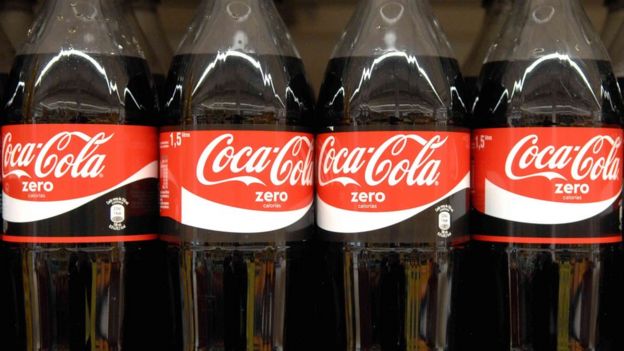
In the US for example, Coca-Cola has been using Google's cloud platform to send videos and discount coupons to customers' smartphones in Albertsons grocery stores.
Digital signs encourage shoppers to find the soft drinks aisle, where they are then targeted with personalised special offers and content based on their online browsing habits and spending profiles.
Image copyrightNEWSCASTImage captionCoca-cola's tie-up with the Albertsons supermarket chain relies on Google Cloud technology
While some see this as an invasion of privacy, the industry sees it as a good example of "location-based" marketing coupled with dynamic pricing.
So in future, the prices you are offered in-store might be for you and you only.
"We can understand who the consumer is and get the right content and messaging to him or her at the right time," Greg Chambers, global group director of digital innovation for Coca-Cola said at a Google conference earlier this year.
"We're using the power of the cloud to bring a real-time, media-rich experience to shoppers in the store."
'Really tough'
And this dynamic pricing trend could be coming to the UK.
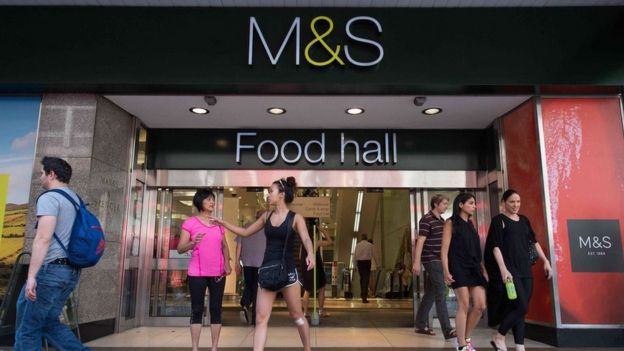
Last year, Marks and Spencer conducted an electronic pricing trial where sandwiches were sold at a discount in the morning to encourage shoppers to buy their lunch early.
While the company isn't currently planning to do this more widely, it comes as several of the large supermarkets are trialling the idea.
Sainsbury's says it ran an electronic pricing trial two years ago - but wouldn't say what conclusions it reached - while Morrisons and Tesco are each currently trying out the system in one of their stores.
They all say that the aim behind the scheme isn't to bring in dynamic pricing, but don't deny that it will make switching between prices easier.
Electronic pricing means supermarkets "will be able to flex their prices a lot more", says Neil Mason, European analyst at market research firm Mintel.
Image copyrightNEWSCASTImage captionMarks & Spencer trialled putting sandwiches on promotion in the morning
"Retail is really tough nowadays - you've got to be quick to respond and e-pricing is the way to do that," he says. "It's about being more efficient and responsive to what is happening in the marketplace.
"They might want to increase prices on certain products because of inflationary pressure, but also might want to decrease prices because of promotions - so it could be good for consumers.
"At the end of the day supermarkets have to be keen on price competition, especially now the big discounters have entered the sector."
In the UK, an intense price war between the discounters, Lidl and Aldi, and the "big four" - Tesco, Sainsbury's, Morrisons and Asda - as well as growing competition from online retailers such as Ocado and Amazon, has taken its toll on profit margins.
On top of that, food prices are rising as inflation pushes up the cost of imports, something that supermarkets are loath to pass on to their customers.
Meanwhile, those customers are feeling the pinch as wages fail to keep up with the cost of living.
In this context, perhaps it was only a matter of time before electronic pricing made the move to UK retail, an area that is constantly looking at ways to innovate.
Image copyrightDISPLAYDATAImage captionElectronic price labels give retailers scope to offer more information as well as variable prices
Displaydata, one of the world's leading suppliers of electronic shelf labels, confirms that electronic pricing's newfound popularity in the UK has transformed their Berkshire-based business.
Chief executive Andrew Dark says: "It's fascinating for us because up until the last 12 months we have been a UK company that was effectively a 100% exporter.
"This phenomenon has been building in Europe and the US and has now arrived on our shores, which is great. I think there are a number of reasons, not least that UK retailers are very conscious of their consumers."
Mr Dark estimates that if the technology were implemented in every store, 10 million prices could be changed within 24 seconds, not only speeding up the process but helping to cut food waste and making pricing more accurate.
"I think most major retail outlets will move to this over the next five years - it's a global trend, not just a UK trend."
Electronic displays like Displaydata's can be operated remotely using wireless technology from a single server and a computer at the retailer's HQ.
Could Overwatch be the game to take e-sports mainstream?
Its developer Activision Blizzard has just announced the first seven team owners for a forthcoming league. It believes, in time, the tournament could prove more lucrative than the UK's Premier League - football's highest-earning competition.
Several of the successful bidders have made their mark with traditional sports teams, and the buy-in price has not been cheap.
The BBC understands the rights cost $20m (£15.5m) per squad. For that, owners get the promise of a 50% revenue split with the Overwatch League itself for future earnings.
The fast-paced cartoon-like shooter was designed to appeal to both players and spectators. It's low on gore and features a racial mix of male and female heroes, including a gay character - a relative rarity in gaming.
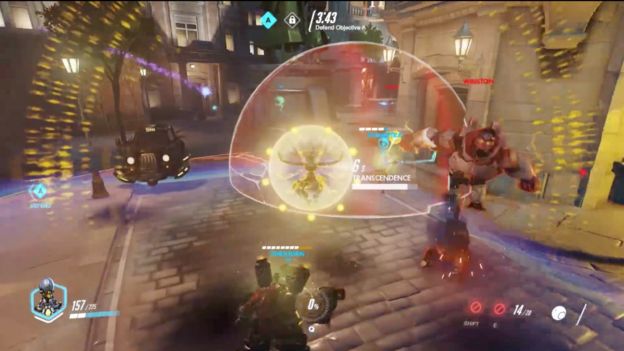
Image copyrightACTIVISION BLIZZARDImage captionPlayers get a first-person view of proceedings but spectators will be shown third-person views
Unlike most e-sports competitions, each team will be based in a different major city to help owners attract home crowds.
And they will pursue the world's biggest consumer brands as sponsors, rather than the kind of games-related businesses usually associated with e-sports.
"If you want to reach 18-to-35-year-olds, you really need to be where they are, and they are playing games," Activision Blizzard's chief executive Bobby Kotick told the BBC.
"The other thing that we offer uniquely is that Overwatch is a very family-friendly game experience. It's a teen-rated game; it's super-colourful, super-friendly.
"And if you look at the geographical diversity of the maps or the ethnic and racial diversity of the characters, those are all things that we took into consideration in the construction of what we thought would be a globally appealing experience."
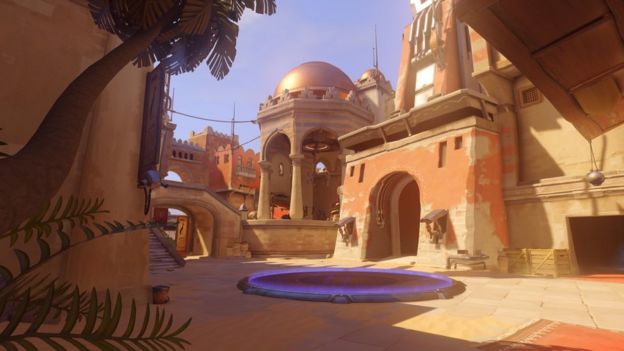
Image copyrightACTIVISION BLIZZARDImage captionOverwatch battles take place in 19 locations across the globe including Egypt and Iraq
To start with, teams are expected to make use of existing venues, but in time Activision Blizzard believes owners will build huge dedicated stadiums of their own.
Fixtures will also be streamed online, and be made accessible from within the game itself.
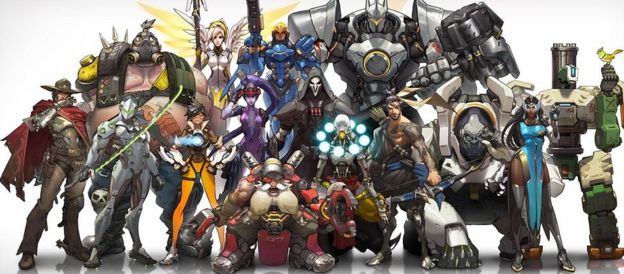
The first-person shooter features about two dozen characters who engage in team-based battles set across a near-future Earth.
Each character has a distinct personality - including a genetically engineered scientist ape, a cowboy-styled bounty hunter and a nerdy-looking climatologist - and unique abilities.
The heroes divide into four broad categories:
offence - fast-moving characters that can inflict a lot of damage quickly
defence - warriors best suited to guarding key parts of the battlefield and repelling attacks
tank - fighters that can sustain a lot of damage and are therefore well-suited to leading attacks
support - champions that help other players heal and access their most powerful attack modes more quickly than normal
Squads of six characters are pitched against each other in a range of challenges, including protecting/capturing a location; defending/destroying a vehicle as it is driven across a zone; and being first to wipe out the enemy team.
Overwatch launched more than a year ago. Numerous awards and a thriving community of about 30 million players prove it has appeal.
Even so, the new league is not guaranteed to succeed on the scale Activision Blizzard hopes.
Critics suggest some potential investors have been put off by a demand that the firm gets a reported 25% cut of any team sale.
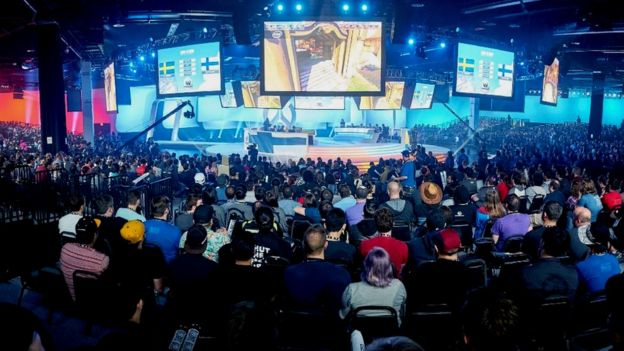
Image copyrightACTIVISION BLIZZARDImage captionOverwatch competitions have already drawn large crowds
And there is concern that ticket and sponsorship sales could be hit by plans to launch a similar venture based on its Call of Duty titles.
Moreover, existing e-sports competitions have yet to collectively make more than £1bn a year - by contrast Premier League clubs jointly earned £3.6bn in the 2015-16 season, according to a recent study.